About Hazard Mitigation
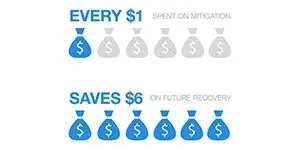
Hazard mitigation is acting before a disaster to reduce consequences later. Mitigation involves analyzing risk, reducing risk, and insuring against risk. One example of a mitigation activity is upgrading a building to not fall during an earthquake. Hazard mitigation is the first step in the disaster cycle, providing powerful prevention to break the expensive cycle of loss.
Mitigation usually occurs before a disaster. But mitigation is essential to the recovery process, too. After a disaster, don't aim for pre-disaster conditions, but rather include mitigation for the next disaster in the rebuilding approach. With a strong mitigation strategy, communities will be safer than before.
About Hazard Mitigation Planning
A few federal acts formalize hazard mitigation:
- Stafford Act of 1988: State and tribal governments must create mitigation plans after receiving federal disaster funds. States include U.S. territories, such as Puerto Rico.
- Disaster Mitigation Act of 2000: Local governments must create Hazard Mitigation Plans to receive non-emergency disaster assistance.
- Disaster Recovery Reform Act of 2018: Creates more incentives and funding sources for hazard mitigation.
States, Tribal, and local governments must create Hazard Mitigation Plans to remain eligible for non-emergency disaster assistance every five years. It must be approved by the Federal Emergency Management Agency (FEMA).
This process is lengthy and typically takes over a year to complete. For more information and official guidance about this process, visit the FEMA website.
Creating a Plan Prioritizing Frontline Communities
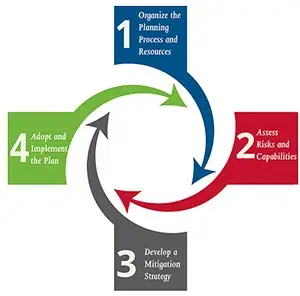
- To organize the planning process and resources, the state, tribal, or local jurisdiction should:
- Identify and build a hazard mitigation planning team that includes many members from frontline communities. Note: Frontline communities may have challenges having trusting relationships with the government and other stakeholders due to historical injustices. Seek out community-based organizations that can help build relationships with residents. Explore using a healing-centered approach to community engagement.
- Outline a planning process that is inclusive and truly accessible to frontline communities:
- Ensure the meeting is accessible for people with limited mobility, vision, and hearing.
- Announce meetings in various publications and venues where frontline communities will see them.
- Hold meetings at variety of times so that those with alternative schedules can attend.
- Provide materials in multiple primary languages used by local frontline communities.
- Food and childcare should be provided.
- Compensate participants.
- To assess risks and capabilities, the planning team should:
- Partner with diverse, technical experts to understand what hazards are possible in the jurisdiction. There is an abundance of resources from regional and local governments in California, including the United States Geological Survey, the California Geological Survey, Adapting to Rising Tides, the California Office of Emergency Services, and many more.
- Seek out other resources to understand risks. For example, Native Americans believe fire is good and a culturally appropriate practice to managing wildfires – this perspective is often missing from official sources.
- Consider lived experience and diverse voices to understand what's at risk and community capabilities. What's at risk is often dominated by wealthier communities with more expensive infrastructure. Similarly, community capabilities often do not consider the social ties and community assets that are foundational to frontline communities.
- Ensure that technical information is easy for frontline communities to read and understand.
- To develop a mitigation strategy, the planning team should:
- Identify and prioritize actions that invest in frontline communities. One example is using funding first to upgrade buildings for earthquakes in economically and socially
disadvantaged neighborhoods. - Consider actions that meet the adaptation goals of the general plan. Read more about the General Plan.
- Identify and prioritize actions that invest in frontline communities. One example is using funding first to upgrade buildings for earthquakes in economically and socially
- To adopt and implement the plan, the planning team should:
- Develop a public comment process open to all, especially frontline communities, and organized with materials in multiple languages.
- Send the plan to the state once it has completed the public approval process and then forward it to FEMA. Once approved, adopt the plan through the local governing body, such as the city council, and implement the plan after adoption by the jurisdiction.
- Identify ways to communicate updates on the implementation process. The NYC Mitigation Plan has a great process in providing updates.
- Develop an ongoing plan maintenance and evaluation process informed by the equity vision outlined at the beginning of the process.
The Benefits of Having a Hazard Mitigation Plan
A Hazard Mitigation Plan helps communities qualify for federal disaster assistance, but just as importantly, it gets neighbors working together to understand local risks, make plans to lessen damage, and build stronger connections that make recovery easier.
The funding benefit is a crucial one for local jurisdictions. FEMA currently administers four active hazard mitigation programs:
- Hazard Mitigation Grant Program (HMGP)
- Building Resilient Infrastructure and Communities (BRIC) Program
- HMGP Post Fire Grants
- Flood Mitigation Assistance Program
Actions to take
For community-based organizations and affordable housing providers
- Learn about the Hazard Mitigation Planning Process in your community. Reach out to the local Office of Emergency Services, Public Safety, or Planning. They are usually the agencies leading this work.
- Offer to be involved in the planning process. This chance only comes up every five years, and it's a pivotal opportunity to influence local efforts to minimize disaster risk.
- Help local governments incorporate equity into the plan by talking about the various benefits it will produce. For example:
- Investments that reduce the risk for frontline communities, reduce social service costs, and save local government future costs.
- Hazard mitigation projects that employ local hiring practices result in a more productive workforce and positively impact the local economy.
- Many investments in frontline communities can achieve co-benefits like community beautification, green space, and tree cover, reducing heat stress and heat-related illnesses.
For local government
- Build relationships with community-based organizations so that they will feel comfortable being on the Planning Team.
- Identify community organizations to be sub-applicants for Building Resilient Infrastructure and Communities (BRIC) funds to conduct planning and mitigation projects to reach difficult to serve populations. This process can help build local organizational capacity and community trust.
- Conduct a building code vulnerability audit and retrofit program that targets frontline communities. This approach would achieve the greatest risk reduction, as these households usually cannot retrofit without support.
- Projects funded by HMGP and BRIC must be considered cost-effective by FEMA's benefit-cost analysis model. Quantifying some goals or values like equity is less common and straightforward. To prioritize equity in the project benefit-cost analysis, local governments need to:
- Use non-market evaluation techniques to conduct the benefit-cost analysis. These may include air quality, tree cover, walkability, and access to green and open space.
- Emphasize local workforce development and ongoing job training opportunities through hazard mitigation investments, rather than only emphasize job creation.
- Quantify the disproportionate benefits that investments in frontline communities yield. For example, determine the risk reduction benefit for mitigating a rental property for low-income renters or low-income homeowners over a more general retrofit program.
- Identify metrics that can be proxies for equity. For example, use a policy that requires that a percentage of hazard mitigation investments serve census tracts or blocks with high Cal EnviroScreen scores.
For philanthropy
- Offer grants to pay frontline communities for their participation in the planning team.
- Lower capacity jurisdictions often do not have enough resources to do hazard mitigation planning, and funding is critical to supporting this work.
- Join the planning process and support the perspective of frontline communities and offer how philanthropy can partner in the effort.
Other helpful resources
- The Federal Emergency Management Agency (FEMA) Region IX produced the Level Up Audio Project to share stories, case studies, and best practices to inspire hazard mitigation action and strengthen the community of hazard mitigation and climate adaptation professionals.
- Guide to expanding mitigation: Making the Connection to Equity.
- The Guidebook for FEMA Hazard Mitigation Grants: Promoting Nature-Based Mitigation Through FEMA Mitigation Grants. Includes an overview of mitigation funding, helpful application tips, and case studies.
Image Sources:
City of Boston
FEMA
The Learning Center’s resources and all data and information provided therein (collectively, “Content”) are for general informational purposes only. All Content is provided “as is” and may no longer be current or up to date. Enterprise Community Partners, Inc., its subsidiaries and affiliated entities (collectively referred to as “Enterprise”) as well as any co-authors of any Content disclaim all liability for any errors or omissions and make no warranties or representations of any kind, either express or implied, regarding the accuracy, adequacy, validity, reliability, availability, or completeness of any Content presented. All Content should be independently verified by you before relying on it. The Content does not constitute professional advice or services (including but not limited to legal, financial, tax, or investment advice).
- Training