Rural communities need more affordable housing — but securing financing remains a major challenge. Aging homes go without repairs, former schools and civic buildings sit vacant at the center of town, and seniors face dwindling options that allow them to stay close to family, services, and community roots.
Even when rural communities have strong local leadership and viable development plans, traditional lenders often struggle to support projects that are smaller, more complex, or located far from major markets.
That's where community development financial institutions (CDFI) like Enterprise Community Loan Fund can play a critical role. As the mission-driven lending arm of Enterprise Community Partners, Loan Fund has spent decades bringing flexible, patient capital to places the market alone can’t always support. In rural communities — where projects tend to be smaller, geographically dispersed, and more complex to finance — that flexibility can determine whether a project moves forward or stalls. Since 2015, Enterprise Community Loan Fund has invested $63.9 million in rural communities in 20 states through 39 loans.
Rural communities don’t lack solutions. What they often lack is capital that understands the local context and is structured to meet projects where they are.
Jon Clarke, Enterprise’s chief lending officer for Loan Fund
Loan Fund provides loans that support projects across their full life cycle — from early predevelopment through acquisition and construction — giving rural developers the time, terms, and creative partners they need to deliver housing their communities depend on.
“CDFIs exist to take on complex projects others sometimes avoid,” said Sharon Bollers, senior director of lending of Loan Fund. “In rural communities, that role is essential to preserving affordability and stability.”
A vacant school becomes a community anchor in Vermont
For more than two decades, Benn High School sat vacant in Bennington, Vermont — a familiar building with deep community roots, but no clear path forward. Closed in 2004, the historic high school remained a prominent reminder of both the town’s past and its unmet needs.
Today, the site is being transformed through a New Markets Tax Credit (NMTC) transaction into a mixed-use community hub that combines 22 units of affordable and workforce housing with 25,000 square feet of community-serving space. When complete, the redevelopment will include a childcare facility, a YMCA-operated fitness center, and offices for the Southwestern Vermont Council on Aging, bringing daily activity and essential services back to the heart of town.
Enterprise Community Loan Fund supported the project with $7 million in bridge financing, helping the development move forward while permanent funding sources were finalized. The housing component includes five units reserved for residents earning under 80% of the area median income (AMI) and 17 units for households under 120% AMI, meeting a critical workforce housing need in the region.
The project also reflects a commitment to sustainability and resilience. Extensive environmental remediation is underway, and the building is being transitioned from fossil fuels to 100% electric operations, with energy-efficient design features that will lower long-term operating and utility costs.
Beyond housing, the impact extends across the community. The redevelopment is expected to create 24 permanent jobs and 92 construction jobs, add more than 100 new childcare seats, and support new YMCA programming serving up to 2,000 people annually.
“These are the kinds of projects where flexible capital is essential,” said Bollers. “You’re not just financing housing — you’re restoring a building that once defined the community and giving it a new purpose.”
Expanding Senior Housing in a Tight Rural California Market
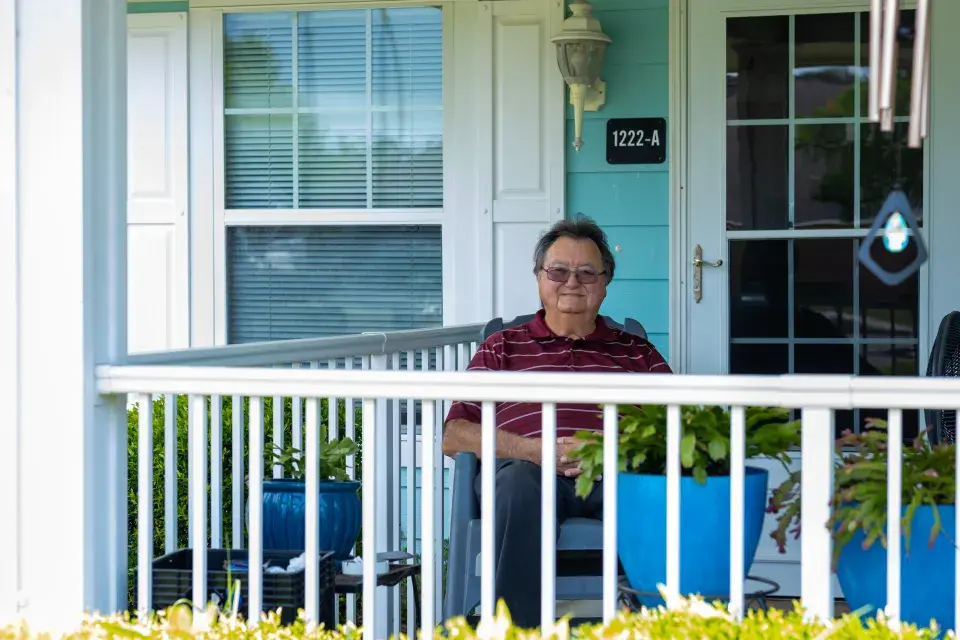
In El Dorado County, California, the cost and scarcity of housing have placed increasing pressure on older residents — many of whom want to remain in the community but have few affordable options.
El Dorado Senior Village Apartments responds directly to that need. The development will deliver 72 units of affordable senior housing, designed to support aging in place through accessible layouts and shared amenities. Residents will have access to a community room, food preparation area, and on-site laundry facilities — spaces that encourage connection and independence. The property will also include a bocce court, pickle ball court, and vegetable garden.
Enterprise Community Loan Fund provided $1.6 million in predevelopment financing, helping the project advance in a market where rising costs can easily stall early-stage planning. Affordability is deeply layered: 25 units are reserved for households earning under 30% AMI and 46 units under 50% AMI, ensuring the development is affordable to seniors on fixed incomes. The project will also have rooftop solar and all-electric appliances to help keep utility costs low for residents.
“In markets across California, including El Dorado County, adding new affordable housing options ensures seniors and families can afford other basic needs like food, medication, healthcare, and transportation,” Eve Goldstein-Seigel, a senior loan officer with expertise in Northern California, said.
Preserving Affordable Homes Across Rural Texas
In rural and semi-rural communities outside the Dallas–Fort Worth metro area, the challenge is not only building new housing but also preserving what already exists. Many affordable properties were built decades ago and require reinvestment to remain safe, livable, and affordable.
Enterprise Community Loan Fund financed the preservation of 133 rental homes across multiple rural communities. The portfolio of four properties, purchased by PK Companies, includes properties built in the 1970s and 1980s and serves populations with limited housing options. The properties were originally financed with USDA Rural Development Section 515 capital, which will remain in the capital stack.
At Heritage Manor in Mineral Wells, Enterprise Community Loan Fund provided $804,000 in acquisition financing to support the purchase and immediate repairs of 36 units of affordable senior housing. The property serves residents with deep affordability needs: 27 units are affordable to households under 30% AMI and nine units under 50% AMI.
A similar approach is underway at Pecan Bend Apartments in Mansfield, a 32-unit property included in the portfolio. There, financing supports acquisition and minor renovations while enabling rent reductions of up to 35% below market. The property includes 22 units affordable under 30% AMI, four under 50% AMI, and six under 80% AMI, helping ensure long-term affordability in a high-cost metro-adjacent area.
“USDA Rural Development programs are foundational for rural housing,” Stephanie Barett, the senior loan officer who led the transaction, said. “As patient and flexible lenders, CDFI capital helps fill the gaps, making it possible to reinvest in older properties, maintain lower rents, and keep homes affordable for the long term.”