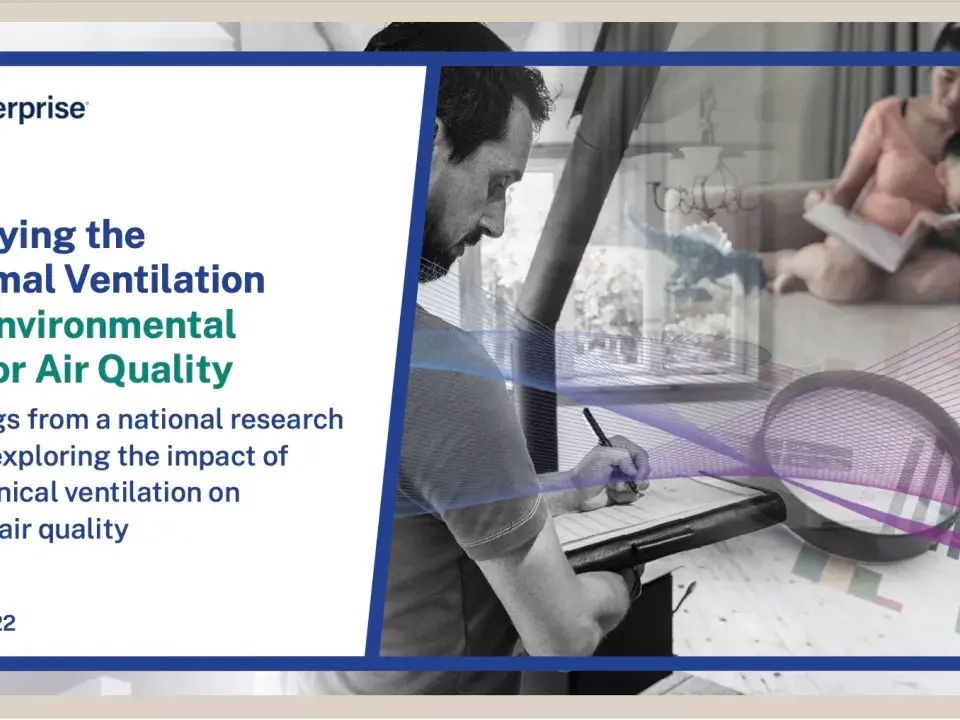
People spend nearly 90 percent of their time inside, making indoor air quality central to health and well-being. Low-income populations are disproportionally affected by a range of illnesses and adverse health effects that can be exacerbated by poor indoor air quality, and improvements to the indoor environment can be an important mechanism to address health disparities.
In Studying the Optimal Ventilation for Environmental Indoor Air Quality, researchers found that mechanical ventilation systems significantly reduced dangerous particulate matter, carbon dioxide, carbon monoxide, and formaldehyde from indoor air, reducing the risk of respiratory and cardiovascular illness. The findings are based on data collected from 2018-2021 by local partners Icahn School of Medicine at Mount Sinai in New York City and the School of Public Health at the University of Illinois Chicago. The report describes the study and its findings in depth and provides a series of recommendations to improve indoor air quality in housing across the country.
The Learning Center’s resources and all data and information provided therein (collectively, “Content”) are for general informational purposes only. All Content is provided “as is” and may no longer be current or up to date. Enterprise Community Partners, Inc., its subsidiaries and affiliated entities (collectively referred to as “Enterprise”) as well as any co-authors of any Content disclaim all liability for any errors or omissions and make no warranties or representations of any kind, either express or implied, regarding the accuracy, adequacy, validity, reliability, availability, or completeness of any Content presented. All Content should be independently verified by you before relying on it. The Content does not constitute professional advice or services (including but not limited to legal, financial, tax, or investment advice).
- Report